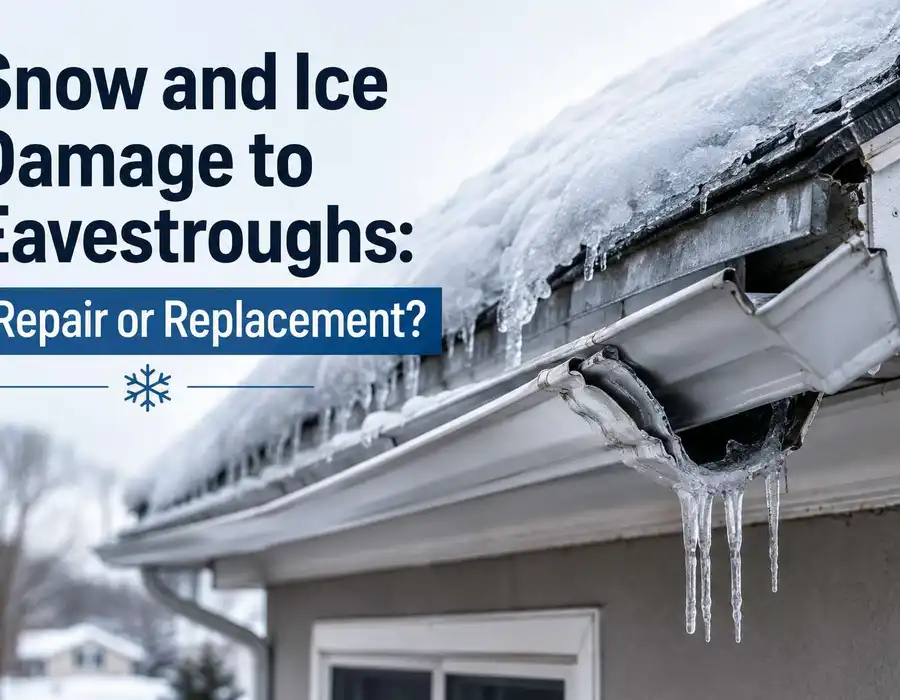
Snow and ice can bend, pull, crack, and loosen eavestroughs, especially during Barrie’s long freeze-thaw winters. Minor leaks or loose brackets can often be fixed with straightforward eavestrough repair, but sagging runs, repeated ice dam damage, split seams, or rotted fascia usually mean replacement is the safer long-term choice.
Why Barrie Homes Are Hard on Eavestroughs
Barrie winters put eavestroughs through more stress than many homeowners expect. Snow builds up on the roof, melts during sunny afternoons, then freezes again at night. That cycle adds weight, blocks drainage, and slowly forces the gutter system out of shape.
An eavestrough is the trough fixed along the edge of your roof that collects rainwater and melting snow, then sends it through downspouts away from your home. When it works well, water leaves the roof in a controlled path. When it fails, water spills near the foundation, runs behind siding, or freezes along walkways.
In Simcoe County, the problem is rarely one single storm. Damage often comes from repeated winter pressure. A small sag in November can become a pulled fastener in January. A clogged outlet can become a block of ice after one thaw-freeze cycle. By spring, the eavestrough may look like it failed all at once, but the damage usually started much earlier.
For homeowners in Barrie, the key question is not only “Can this be fixed?” The better question is “Will this repair hold up through another winter?”
How Snow and Ice Damage Eavestroughs
Snow and ice damage eavestroughs by adding weight, blocking flow, and changing the direction water moves along the roof edge. Once drainage slows, every freeze makes the problem worse.
Heavy snow presses down on the front lip of the gutter. Ice inside the trough adds even more weight. If brackets or hangers are already loose, the eavestrough can pull away from the fascia board — the same chain reaction covered in our guide to why eavestroughs sag. The fascia is the long board behind the eavestrough. It gives the gutter system support and helps finish the roof edge. If that board softens from water, even new screws may not hold.
Ice dams are another common winter issue. An ice dam forms when melted snow runs down the roof and refreezes near the colder roof edge. This can trap water behind the ice. That trapped water may push under shingles, spill into the eavestrough, or freeze around the gutter line.
Downspouts can also freeze. When the downspout outlet is blocked, meltwater has nowhere to go. It sits in the eavestrough, turns to ice, and expands. That expansion can open seams, split corners, and push sections out of alignment.
The damage is mechanical and moisture-related at the same time. The ice pulls the system down. The water gets behind it. Then the next freeze locks the damage in place.
Signs Your Eavestroughs May Only Need Repair
Repair makes sense when the damage is small, local, and the rest of the system is still strong. A good repair should fix the cause, not just hide the symptom.
Small leaks at one seam can often be sealed if the metal is still straight. A loose bracket may be refastened if the fascia behind it is solid. One low spot may be corrected if the eavestrough has not twisted or stretched. A disconnected downspout can usually be reattached unless the outlet is cracked or crushed.
Look for these repair-friendly signs:
- One or two small leaks
- A short section pulling slightly away from the fascia
- Minor sagging in one area
- Loose hangers or brackets
- A clogged or disconnected downspout
- Overflow caused by debris, not poor slope
- No visible rot behind the eavestrough
The most important repair test is drainage. Water should move toward the downspout without sitting in the trough. Eavestrough slope is the slight angle that helps water flow in the right direction. If the slope can be reset and the metal still holds its shape, repair may be enough.
For a Barrie homeowner, repair is often the right call after a first-time issue. For example, if one hanger pulled loose after a heavy snowfall but the rest of the run is straight, replacement would be excessive. The better fix would be to secure the section, check the fascia, clear the outlet, and confirm water drains properly.
Signs Replacement Is the Better Choice
Replacement is usually the better choice when the eavestrough has lost its shape, failed in several places, or no longer protects the home from water. Once a gutter system bends too far, it may never carry water correctly again.
Sagging along a long run is a major warning sign. It means the system has either pulled from the fascia, stretched under ice weight, or lost its slope. Even if it can be pushed back up, the metal may be weakened. The same problem often returns after the next heavy snow.
Multiple leaking seams also point toward replacement. Older sectional eavestroughs have joints where water can escape. Once several seams open, sealing one at a time becomes a short-term patch — and if the leaks look more like tiny punctures than open seams, see our guide on small holes and pinhole leaks in aluminum eavestroughs for the difference. Seamless eavestroughs reduce that weakness because they have fewer joints across long roof edges.
Replacement is also smarter when the fascia board is damaged. Screwing a damaged eavestrough into soft wood does not solve the problem. The new fasteners may pull out again, and water can continue entering the roof edge.
Choose replacement when you notice:
- Long sections sagging or bowing
- Eavestroughs pulling away from the house
- Cracks, splits, or crushed corners
- Repeated leaks after past repairs
- Rust, holes, or thin metal
- Water spilling behind the gutter
- Rotten fascia or damaged soffit
- Ice damage across several roof edges
- Poor drainage even after cleaning
The decision also depends on age. If the system is near the end of its useful life, repairing winter damage may only delay the expense. In that case, replacement gives you a chance to correct slope, improve downspout placement, and reduce future ice problems.
Repair vs Replacement: A Simple Decision Guide
The best choice comes down to three things: damage size, system condition, and future risk. A repair is worth doing when it restores full function. Replacement is worth doing when repairs would leave weak points behind. Our full repair vs replacement guide and repair cost breakdown go deeper into both sides of this decision.
| Condition | Repair May Work | Replacement Is Better |
|---|---|---|
| Leak location | One small seam or corner | Several seams leaking |
| Shape | Mostly straight | Bent, twisted, or sagging |
| Fascia | Solid wood | Soft, rotted, or stained |
| Drainage | Water reaches downspout | Water pools after cleaning |
| Damage history | First winter issue | Same issue keeps returning |
| Ice impact | Localized spot | Damage across long runs |
| Age | Newer system | Older or worn system |
A useful rule is this: repair the part when the system is healthy; replace the system when the damage shows a pattern.
For example, one leaking corner after an ice buildup may need resealing. But if that corner leaks, the middle sags, and the downspout freezes every winter, the system is not just damaged. It is failing as a drainage design.
Why Small Winter Damage Should Not Be Ignored
Small eavestrough damage can lead to larger home repairs because water always follows the easiest path. If the gutter no longer controls that path, water may move into places it should never reach.
A small gap behind the eavestrough can send meltwater down the fascia — this is exactly the failure covered in our guide to water running behind the eavestrough. Over time, that moisture can stain the soffit, soften wood, and invite pests. Overflowing water can also fall near the foundation. In winter, that water freezes on steps, driveways, and walkways, creating slip hazards.
In spring, the same failure can cause basement moisture. When snow melts fast, a weak eavestrough system may dump large amounts of water beside the house. If grading is poor or the downspouts are short, that water can collect around the foundation wall.
This is why winter gutter damage should be checked before the next heavy thaw. A small repair in the roof drainage system is usually cheaper than fixing fascia, siding, foundation seepage, or ice-damaged landscaping.
The Role of Downspouts in Winter Eavestrough Damage
Many homeowners focus on the horizontal trough and miss the downspouts. But a blocked or undersized downspout can be the reason the eavestrough failed in the first place.
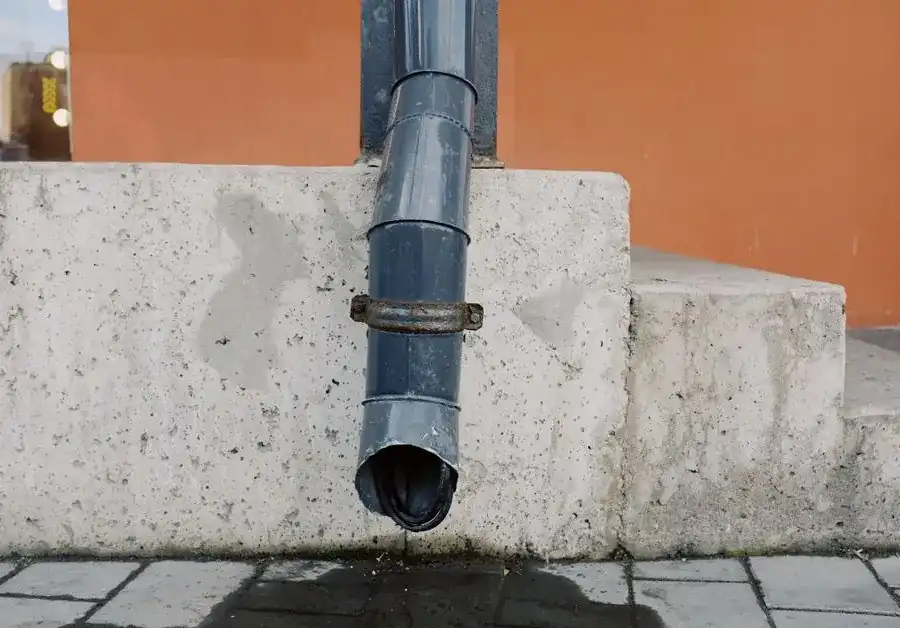
A downspout is the vertical pipe that carries water from the eavestrough to the ground. It should move water far enough away from the home so it cannot pool near the foundation. If it is clogged with leaves, frozen at the elbow, or crushed near the bottom, water backs up into the eavestrough.
That backup matters in winter because standing water becomes ice. Ice adds weight. Weight bends the trough. The bent trough then holds more water. This creates a loop where each thaw and freeze makes the damage worse.
Downspout placement also affects performance. A long roof run with too few downspouts may drain slowly during heavy melt. In Barrie, where snow can melt quickly during mild spells, slow drainage can turn into ice buildup overnight.
A proper inspection should check the full water path: roof edge, eavestrough, outlet, downspout, extension, and discharge area. Replacing a damaged trough without fixing poor downspout flow can lead to the same winter damage again.
What a Proper Repair Should Include
A good eavestrough repair should restore support, slope, sealing, and drainage. Anything less is a patch.
First, the damaged area should be cleaned and cleared of debris. Sealant does not bond well to dirty or wet surfaces. If ice caused the damage, the area should be checked for pulled fasteners and bent metal. A leak is often only the visible part of the problem.
Next, the slope should be checked. If water sits in the trough after the repair, the issue is not solved. The eavestrough may need to be lifted, rehung, or adjusted so water moves toward the downspout.
The fascia should also be inspected. Fasteners need solid backing. If the wood is soft, stained, or crumbling, the fascia may need repair before the eavestrough can be secured.
A strong repair may include:
- Resealing one corner or seam
- Replacing loose hangers
- Refastening a short pulled section
- Adjusting the slope
- Clearing outlets and downspouts
- Adding or correcting downspout extensions
- Fixing small dents that affect water flow
The goal is simple: after the repair, water should enter the trough, move to the downspout, and drain away from the home without leaks, overflow, or pooling.
What Replacement Should Solve
Eavestrough replacement should do more than swap old metal for new metal. It should fix the reason the old system failed.
A proper replacement should improve drainage layout, support strength, and winter performance. That may mean using seamless runs where possible, adding enough hangers, setting the correct slope, and placing downspouts where water can leave quickly.
In snow-heavy areas like Barrie, hanger spacing matters. More secure support helps the eavestrough handle winter weight. The system also needs enough outlets. A long run with one small downspout may work during light rain but struggle during spring melt.
Replacement can also address roof-edge problems. If water has been spilling behind the eavestrough, the fascia, soffit, and drip edge should be checked. A drip edge is the metal flashing at the roof edge that helps guide water into the eavestrough instead of behind it. Without proper water direction, even a new gutter can leak at the back.
The best replacement solves these questions:
- Does water leave the roof cleanly?
- Does the eavestrough have enough slope?
- Are there enough downspouts?
- Is the fascia strong enough to support the system?
- Will the gutter handle future snow and ice better?
- Does water discharge away from the foundation?
If replacement does not answer these questions, it may repeat the same failure with newer materials.
Can Gutter Guards Prevent Snow and Ice Damage?
Gutter guards can help reduce clogs, but they do not make eavestroughs immune to snow and ice. Their main job is to keep leaves, needles, and debris out of the trough. Cleaner gutters drain better, and better drainage can lower the risk of ice buildup.
But guards are not a cure for ice dams. Ice dams are often linked to heat loss, roof temperature, attic ventilation, and roof-edge freezing. If warm air from the home melts snow on the upper roof, that water can still refreeze near the edge, even with guards installed.
For Barrie homes with many trees, gutter guards may be useful because autumn debris can block winter drainage. The benefit is indirect: fewer clogs mean less standing water, and less standing water means less ice weight inside the trough.
The right expectation is important. Gutter guards can reduce maintenance and help water flow. They cannot fix poor slope, weak fascia, bad attic insulation, or a roof design that sheds heavy snow directly into the eavestrough.
How to Reduce Future Snow and Ice Damage
Prevention starts before winter. Eavestroughs should be cleaned in late fall after most leaves have dropped. Downspouts should be flushed so water can leave the system before freezing weather arrives — this kind of seasonal eavestrough maintenance is the single best way to avoid a winter callout.
Roof drainage should also be watched during the first major thaw. If water spills over one area, that spot may be clogged, sagging, or sloped the wrong way. Catching the issue early can prevent ice from building in the same weak spot all winter.
Homeowners can reduce future damage by:
- Cleaning eavestroughs before winter
- Keeping downspouts open and extended
- Fixing small sags before they worsen
- Replacing weak hangers
- Checking for water behind the gutter
- Watching for ice buildup in the same area
- Improving attic insulation and ventilation if ice dams form often
- Trimming branches that drop debris onto the roof
Safe snow management also matters. Pulling ice from eavestroughs with force can bend the metal or tear the system loose. Climbing ladders in icy weather is dangerous. If the eavestrough is packed with ice, the safer choice is to address the cause and have the system inspected when conditions allow.
Cost Logic: When Paying for Repair Makes Sense
Repair makes financial sense when the cost is low, the damage is isolated, and the system still has years of service left. It also makes sense when the issue has a clear cause, such as one clogged downspout or one loose bracket.
But repeated repairs can become more expensive than replacement. If you pay to reseal the same seam every spring, the real problem may be movement, poor slope, or worn material. In that case, the repair is treating a symptom.
Think in terms of risk, not just price. A cheap repair that fails during the next thaw can lead to water near the foundation or damage behind the fascia. A higher upfront replacement may cost less over time if it removes several weak points at once.
A good decision should compare:
- Repair cost today
- Age of the system
- Number of damaged areas
- Risk of water damage
- Likelihood of another winter failure
- Whether the repair fixes the cause
The lowest price is not always the lowest cost. The best value is the option that keeps water moving away from the home through the next winter and beyond.
When to Inspect Eavestroughs After Winter
The best time to inspect eavestroughs is after major thaw periods and again in early spring. Winter damage is easier to see when snow and ice have melted but before spring rain becomes heavy.
Walk around the home and look from the ground. Check for sagging, gaps, stains, dripping corners, and downspouts that have pulled away. Watch where water exits during rain. If it spills over the front, leaks behind the trough, or pools beside the house, the system needs attention.
Inside the home, watch for signs that roof-edge drainage may be failing. Stains near exterior walls, damp basement corners, or musty smells after snowmelt can point to water management issues outside.
A spring inspection is also useful because repairs can be handled before the next winter. Waiting until freezing weather returns limits repair options and can turn small issues into urgent problems.
Repair or Replace? The Best Answer for Barrie Homeowners
Repair your eavestroughs if the damage is minor, the system is still straight, the fascia is solid, and water drains properly after the fix. Replacement is the better choice if snow and ice have caused long sagging sections, repeated leaks, poor drainage, pulled fasteners, damaged fascia, or failures across more than one area.
For Barrie homes, winter performance should guide the decision. A system that barely works in summer rain may fail under snow load and freeze-thaw stress. Strong eavestroughs are not just about keeping rain off the siding. They protect the roof edge, foundation, walkways, and basement from water that moves in the wrong direction.
The safest approach is to treat snow and ice damage as a drainage problem, not just a gutter problem. Once you know whether the issue is local or system-wide, the repair-or-replacement choice becomes much clearer. Request a free post-winter inspection and we’ll tell you exactly where your system stands before the next freeze.
Think You Might Need Eavestrough Work?
Get a free, no-obligation assessment for your Barrie home.